
By Nahida Akter
As the full moon rises high in the autumn sky, the families across China and many parts of Asia gather to celebrate one of the most enchanting holidays of the year, which is the Chinese Moon Festival, also known as the Mid-Autumn Festival (中秋节 Zhōngqiū Jié).
This centuries-old tradition, held on the 15th day of the 8th lunar month, is more than just a celebration of the harvest rather it’s a heartfelt tribute to family for unity, gratitude, and the beauty of the moon.
🌝 A Festival Rooted in Myth and Meaning
Long ago, there lived a legendary archer named Hou Yi, renowned for his extraordinary skill with the bow. His wife was the graceful and kind-hearted Chang’e. One year, a catastrophic event occurred when ten suns rose into the sky at once,scorching the earth and bringing suffering to the people. Hou Yi bravely acted, shooting down nine of the suns, leaving just one to light the world.
Impressed by his heroism, an immortal gifted Hou Yi an elixir of immortality. However, Hou Yi cherished his life with Chang’e and didn’t want to live forever without her. So, he entrusted the elixir to her for safekeeping.
Unfortunately, one of Hou Yi’s apprentices, Peng Meng, discovered the secret. On the 15th day of the 8th lunar month, while Hou Yi was away hunting, Peng Meng broke into their home and tried to steal the elixir. Refusing to give it up, Chang’e made a fateful decision. She drank the elixir herself and ascended to the heavens.
Out of love for her husband, Chang’e chose to reside on the moon, where she could remain close to him. When Hou Yi returned and learned what had happened, he was heartbroken. To honor her, he placed her favorite fruits and cakes in the yard and made offerings to her spirit.
Touched by the story, people across the land began to do the same. They all gather under the full moon sharing food and paying tribute to Chang’e. This tradition became the heart of the Mid-Autumn Festival, a celebration of love, sacrifice, and reunion.
According to Chinese folklore, she drank a magical elixir and ascended to the moon, where she lives in solitude. Her story is about love, sacrifice, and longing themes that echo through the festival’s customs and poetry.
The round and radiant full moon symbolizes wholeness and reunion, making this festival a time for families to come together, even if only in spirit.
🥮 Mooncakes and More: Traditions that Shine
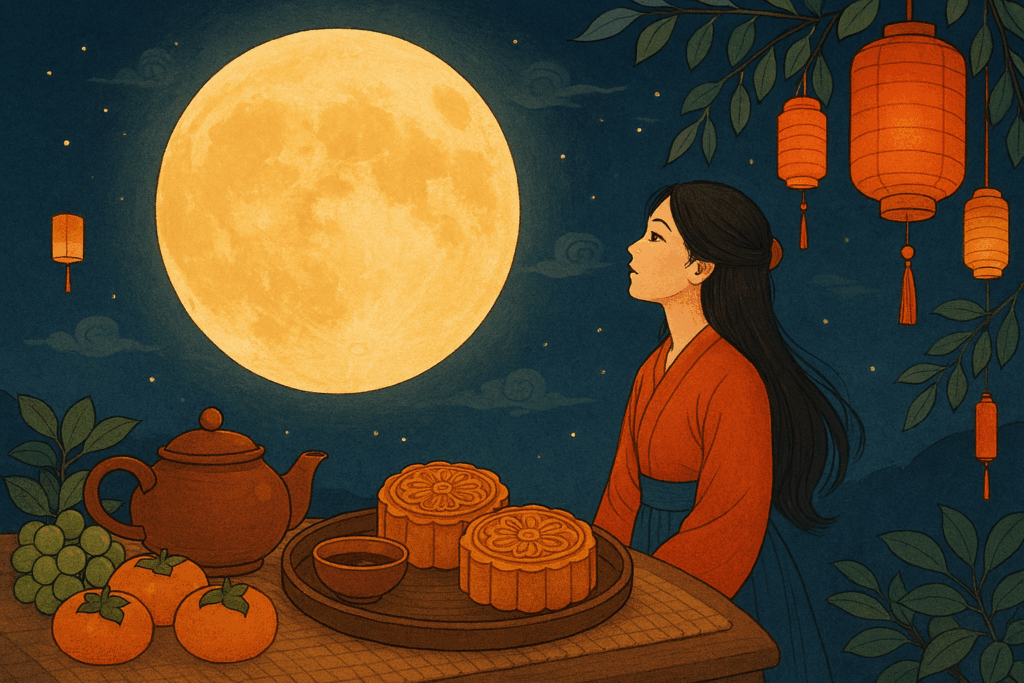
No Moon Festival is complete without mooncakes which is rich, round pastries filled with lotus seed paste, red bean, or salted egg yolk. These treats are exchanged as gifts and shared among loved ones, representing unity and good fortune.
Other beloved traditions include:
- Lanterns: Children and adults alike light colorful lanterns, sometimes solving riddles written on them.
- Moon Gazing: Families gather outdoors or by windows to admire the full moon, often reciting classical poems.
- Festive Meals: Tables overflow with seasonal fruits, tea, and dishes that vary by region.
🌏 A Celebration Beyond Borders
While deeply rooted in Chinese culture, the Moon Festival is celebrated in many countries, including Vietnam, Singapore, Malaysia, and Taiwan, each adding its own local flavor. In Vietnam, for example, it’s known as Tết Trung Thu and is especially focused on children and lantern parades.
Even in modern cities, the festival continues to evolve with virtual moon-gazing parties, creative mooncake flavors, and public lantern displays lighting up parks and streets. Especially, the Chinese community in U.S. organizes this festival every rear.
✨ Why the Moon Festival Still Matter
In a fast-paced world, the Moon Festival offers a moment to pause, reflect, and reconnect with nature, with loved ones, and with tradition. Whether you’re sharing mooncakes with family or simply admiring the moon from your balcony, this festival reminds us of the enduring power of togetherness and hope.
So, this Mid-Autumn, look up at the moon, savor a sweet bite, and let the light of tradition warm your heart.